Rahpooye Honar-Ha-Ye Tajassomi

Rahpooye Honar-Ha-Ye Tajassomi

Number of Volumes 9
Number of Issues 31
Number of Articles 240
Number of Contributors 378
Article View 710428
PDF Download 504,044
View Per Article 2960.12
PDF Download Per Article 2100.18
Number of Submissions 720
Acceptance Rate 26
Time to Accept (Days) 282
Number of Indexing Databases 12
Number of Reviewers 107

According to license number 19925 dated 1 May 2023 issued by the General Press Department of the Ministry of Culture and Islamic Guidance, the previous title of the publication "Rahpooye Honar/Honar-Ha-Ye Tajassomi" was modified to the new title "Rahpooye Honar-Ha-Ye Tajassomi".


Journal of Rahpooye Honar-Ha-Ye Tajassomi is an open-access, double-blind, peer-reviewed publication published by Soore University concerned with new concepts and innovative technologies in the field of visual arts. Rahpooye Honar-Ha-Ye Tajassomi is a quarterly publication, which publishes original research papers related to journal scope. This journal follows the Committee on Publication Ethics (COPE) and complies with the highest ethical standards by ethical laws. All submitted manuscripts are checked for similarity through Hamanandjoo (IRANDOC) software to ensure their authenticity to be assured about its originality and then rigorously peer-reviewed by expert reviewers.  (Read More...)


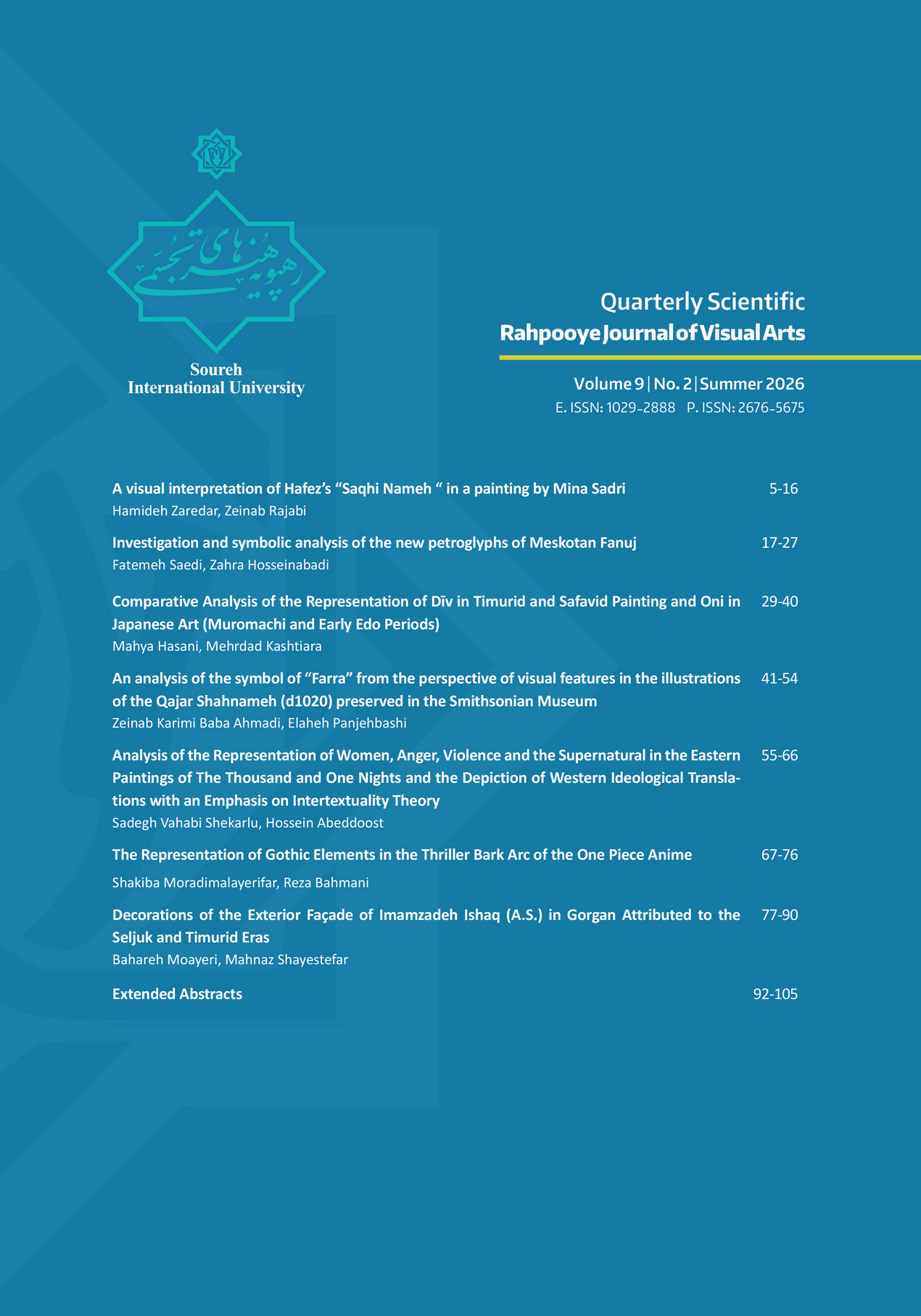
Current Issue: Volume 9, Issue 2, Summer 2026 

Keywords Cloud

  • Painting
  • Iranian painting
  • Semiotics
  • Iconology
  • design
  • transtextuality
  • Photography
  • calligraphy
  • Iconography
  • art
  • myth
  • Qajar
  • Adaptation
  • hypertextuality
  • Miniature
  • persian painting
  • Gerard Genet
  • Roland Barthes
  • Complexity
  • Industrial Design
  • Iranian Artists
  • Islamic architecture
  • Ali Akbar Sadeghi
  • intertextuality
  • Illumination
  • Herat School
  • Mural Painting
  • symbol
  • Rock Art
  • Metamorphosis
  • Design thinking
  • Gilbert Durand
  • Timurid period
  • Animation
  • Contemporary Art
  • John Szarkowski
  • Cultural semiotics
  • Manga
  • Contemporary Painting of Iran
  • Iranian contemporary painting
  • Design process
  • Shahnameh
  • Urban furniture
  • Modernism
  • Islamic art
  • People with disabilities
  • Contemporary Iranian Painting
  • stylistics
  • Iran
  • habitus
  • Sultan Mohammad
  • Cartier-Bresson
  • Textile
  • Kuhdasht
  • Manuscript
  • Archetype
  • defamiliarization
  • Taq-e Bostan
  • Logotype
  • Grotesque
  • Enghelab Street
  • Qajar Art
  • Parviz Tanavoli
  • Imposed war
  • Color
  • Decisive Moment
  • power
  • Imagination
  • Aesthetic Experience
  • Traditional arts
  • creativity
  • Poem
  • Street photography
  • Pop Art
  • Morphology
  • Visual Perception
  • chaos
  • Mithraism
  • Plato
  • Kufic
  • Surrealism
  • Lithograph
  • Discourse
  • Beauty
  • Michel Foucault
  • Religion
  • Pottery
  • Ferdowsi\'s Shahnameh
  • User Interface Design
  • Islamic Revolution of Iran
  • Gerard Genette
  • multiplicity of color
  • Contemporary Iranian Painters
  • Abdul Mo\'men ibn Mohammad Al-Naqash Al-Khoei
  • Mughal period
  • inscription
  • Bakhtin
  • ideology
  • Peony
  • carpets
  • Kress and Leeuwen
  • Mythanalyse
  • art of the book
  • ade
  • Art Globalization
  • Mehran Saber
  • Qoran
  • Visual Signs
  • exhibition director
  • Short Animation
  • Marvin Minsky
  • Modern Iranian Art
  • The narration of Ashura
  • St. Augustine
  • Fereydun
  • Collective Unconscious
  • evolution documentry of education
  • Dionysian matter
  • Merleau-Ponty
  • Ico-nic Photograph
  • Emad al-Kottab Shahnameh
  • Royal Jewelry
  • mural
  • Shia thought and current
  • Siah Qalam
  • Saqinameh
  • Varqa and Golshah
  • Hero’s Journey
  • fractal dimension
  • handweaves
  • \"Zodiacs\"
  • Isfahan
  • Sheikh Ahmad Jami collection
  • Packaging
  • Commercial Press Advertisements
  • poetry
  • Trans- Semiotic
  • The myth of Ayin
  • Exoticism
  • Hamza-nama
  • Khamsah (Add ms 25900)
  • Gestalt principles of visual perception
  • Coffee-house painting
  • Mourning Cus toms
  • Neolithic Painting
  • Mughals of India
  • tile painting
  • Shahnameh Baisanghari
  • Gilles Deleuze
  • Souvenir Photography
  • Sasanian
  • Zandieh
  • Seljuq period
  • pakistani contemporary art
  • Design-Driven Innovation
  • the Court of Kiomars
  • Semiology of the colour
  • Futures study of art
  • Neo_miniature
  • Duolingo Application
  • Zand Rug
  • Iranian View-Point In Photography
  • Habib Mohammadi
  • Visual Structure of Emblems
  • Creative Industries
  • Mescotan
  • human motifs
  • history
  • Simulation
  • Sassanid art
  • Samacheh
  • Volume
  • Jerome Stolnitz
  • First Pahlavi
  • Historical
  • Shapur I
  • Dramatic Situations
  • Saqqakhaneh
  • Pictorial Representation
  • Mary Ellen Mark
  • The Last Judgment
  • process
  • Lucy Lipard
  • Public Art
  • hermeneutic horizon
  • Deccani Miniature Painting
  • Jani Farangi-Saz
  • pictogram
  • EStella Tse
  • scorpion symbol
  • Difference
  • Iran’s contemporary painting
  • Divan Hafez
  • Mikael Barati
  • image and visual elements
  • Ismail Jalayer
  • Japanese painting
  • Master-Apprenticeship Approach
  • hypotexts
  • Egyptian mythology

Related Journals